
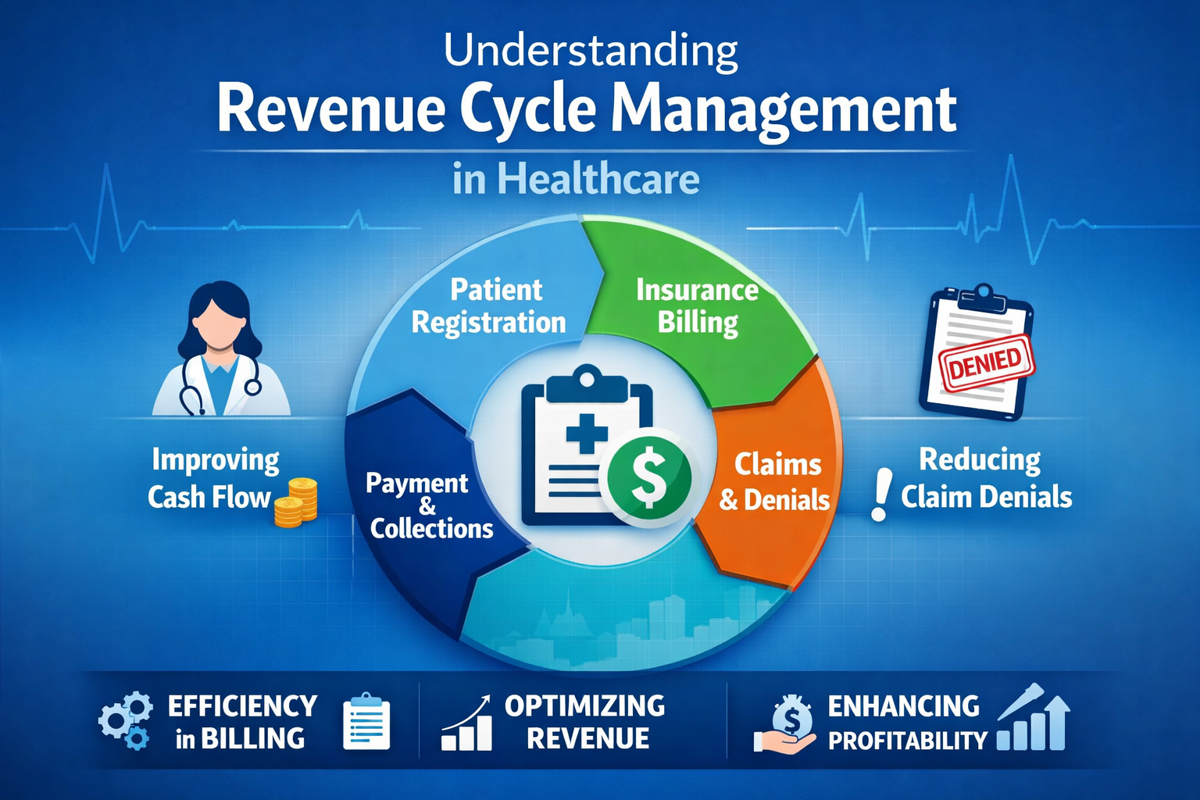
Understanding Revenue Cycle Management in Healthcare | Key Insights
- Health
- Rana Asad Jamil
- 2026-03-26 18:00:59
- 565656
The revenue cycle begins the moment a patient schedules an appointment and continues until all charges are collected. Gaps or errors anywhere—from missing insurance details at registration to coding mistakes or unaddressed denials—can trigger rejections and delays. In effect, RCM is the bridge between care delivered and revenue collected. Strong RCM means smoother cash flow and happier patients; weak RCM means paperwork bottlenecks and lost revenue.
Core RCM Components and Workflows
RCM breaks down into several core components. Patient access is first: capturing correct insurance and demographic information and verifying eligibility. Next comes coding and charge capture: assigning the correct CPT/ICD codes and modifiers based on the documentation. Then claims submission – sending claims accurately to payers – and denials management, where rejected claims are researched and resubmitted in medical billing services. Finally, patient collections address copays and outstanding balances. Each step must work seamlessly: for example, insurance entered at check-in must match the plan that ultimately adjudicates the claim.
RCM is iterative. Errors early on compound later. (A missing modifier may lead to a denial months after service.) Official resources emphasize that tracking KPIs can spot trouble. CMS and industry sources cite key RCM metrics: Clean-claim rate, denial rate, days in A/R, and net collection rate. Clean-claim rate measures the percentage of claims accepted by payers without edits; industry experts often target mid-90%s (high-90%s for top performers). Denial rate is the percentage of submitted claims denied; industry benchmarks are roughly single digits (e.g. 8% is often cited as an average target). Days in A/R and net collection rate vary widely by specialty and payer mix (no single “official” benchmark is published), but practices generally aim to minimize days in A/R and keep net collections high (e.g. most strive for net collection rates in the 90%+ range). In short, good RCM yields high clean-claims and low denials (ideally <5–10%, depending on context). (If you see a source quoting specific benchmarks, use them cautiously; formal benchmarks are not established by CMS or OIG, so treat them as unofficial.)
RCM’s Impact on Revenue and Patient Experience
The effects of RCM on revenue are dramatic. CMS data show a ~6.55% error rate in Medicare payments (about $28.83 billion in 2025). Each denied or corrected claim delays cash and adds cost – AHIMA estimates roughly $25 in staff time per denial just to fix it. In contrast, high clean-claim rates and rapid billing mean faster payment and fewer write-offs. Qualitatively, strong RCM frees staff for patient care and reduces billing hassle, improving patient satisfaction. Weak RCM does the opposite: frustrated patients (surprised by bills or collection calls), strained staff, and negative financial outcomes. Over time, unchecked RCM errors can even trigger compliance risks (the HHS OIG highlights that repeated billing inaccuracies may lead to audits or penalties).
Illustrative vignettes
Consider two anonymized examples. Vignette 1 (RCM failure): A clinic schedules an imaging study without verifying authorization. The payer denies the claim for lack of prior auth. Billing must appeal and resubmit with documentation, delaying reimbursement by months. The back-and-forth consumes staff hours and costs the practice significant delayed cash. Vignette 2 (RCM fix): The same clinic implemented a workflow “gate” at scheduling. The front-desk staff now uses an EHR-driven checklist to verify authorizations before the visit. Denials from missing authorizations drop to near zero, and staff time shifts from rework to patient outreach. Patient billing becomes predictable (with co-pays collected at check-in), improving the patient’s experience. In one peer-reviewed study, 1.34% of preventive-care claims were denied and about 0.51% were billing errors; among denials that did result in charges to patients, the median bill was $630. These are small percentages, but each error can mean a big surprise to a patient or a big headache to staff.
Best Practices and Technology Solutions
Successful practices build guardrails into RCM. Staff training is essential: everyone (intake clerks, clinicians, billers) needs up-to-date coding knowledge and clear SOPs. Regular internal audits (sample claims reviews) catch systematic errors early. Use technology wisely: integrated EHR/RCM platforms can automate eligibility checks and flag missing authorizations at scheduling. Advanced claims-edit software (CMS’s NCCI logic, etc.) can pre-flight claims for disallowed code combos. RCM analytics dashboards help monitor KPIs in real time (e.g. spotting a spike in denial rate by payer). Keep code sets current: the AMA releases hundreds of CPT changes each year (e.g. CPT 2025 had ~420 updates) and ICD-10-CM guidelines change annually (FY2026 guidelines updated Oct 1, 2025). Building a quick-update routine – say, a quarterly review of key code changes – prevents outdated coding from eroding revenue. In short, automate what you can and audit the rest. Studies show that practices using RCM software, combined with ongoing coder education and feedback, see measurable improvements in clean claims and net collections.
Conclusion and recommended next steps
An efficient RCM is like sharpening a saw: it directly sharpens your revenue without more clinical hours. Practice managers should treat billing accuracy as a continuous quality initiative. Start by measuring current performance: what is your clean-claim rate and denial rate? Then fix the biggest leaks (even if it means revising front-desk checklists or retraining staff). Use technology to automate rules and provide visibility. Over time, a well-oiled revenue cycle boosts cash flow and patient trust. Don’t wait for a payer audit – own your revenue process now.
Recommended next steps:
- Assess and prioritize: Review recent denials and A/R aging. Identify the top two preventable issues (e.g. eligibility errors, coding mistakes) and fix them end-to-end.
- Audit and train: Launch a small internal audit program (e.g. 10 charts/month) and give quick, role-based feedback (front-desk vs. coder). Track whether error rates improve.
- Automate controls: Build workflow checks into your EHR/RCM (eligibility checks, required fields for authorizations, automated denial-flag alerts) and update code tables annually (CPT/ICD).
Each step reclaims revenue and staff time, ultimately improving both the practice’s bottom line and the patient’s billing experience. Own your revenue cycle like a quality metric, and make continuous improvement visible month over month.
Sources: Official Medicare/CMS data and guides, AHIMA and OIG compliance guidance, and peer-reviewed analyses were used to inform this summary. Each recommendation is supported by authoritative industry data.
565 people like this















About Premium Author
This post has been authored and published by one of our premium contributors, who are experts in their fields. They bring high-quality, well-researched content that adds significant value to our platform.