
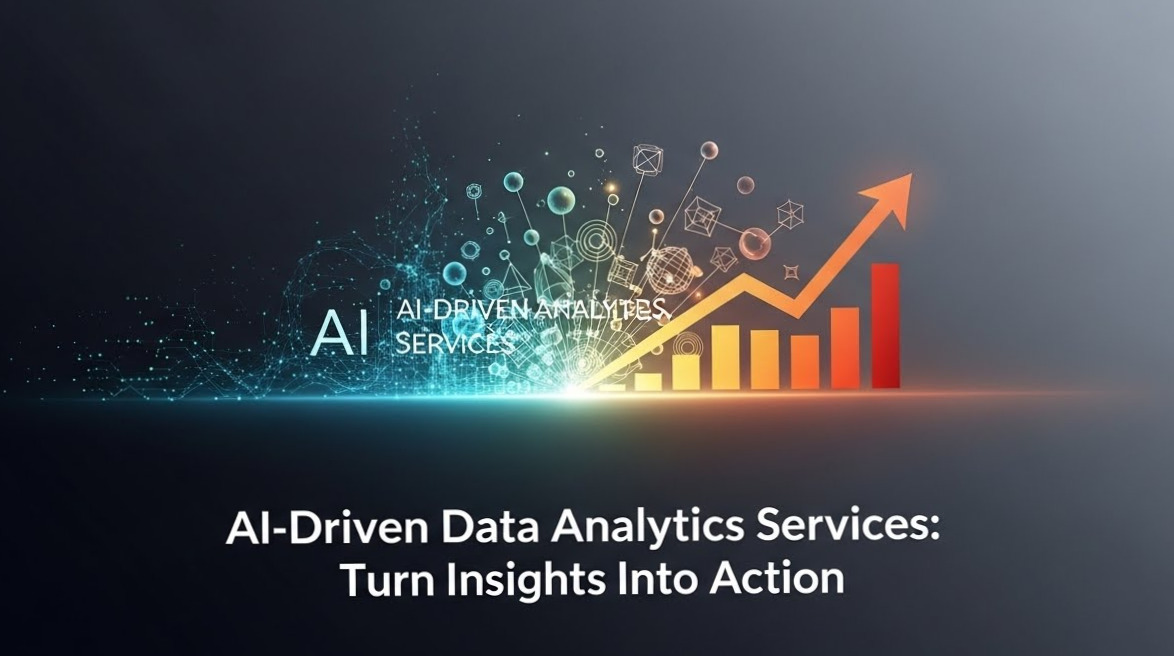
AI-Driven Data Analytics: Turn Insights Into Action
- Technology
- Ghulam Fareed
- 2026-07-27 17:03:51
- 566096
Most companies today are drowning in data but starving for clarity.
Every department generates dashboards, reports, and spreadsheets, yet senior teams still struggle to answer basic questions:
What’s actually happening? Why is it happening? And what should we do next?
That’s where AI-driven data analytics services come into play, not as flashy add-ons, but as systems that transform raw information into actionable insights.
After spending the past year evaluating different AI consulting and analytics firms, I’ve seen what works, what doesn’t, and why the gap between insights and action is still painfully wide in many organizations.
The firms that stood out were the ones that treated analytics as a business system, not a technical exercise.
What AI-Driven Data Analytics Services Actually Do
The biggest misconception is that AI analytics is just “better dashboards.” But most companies don’t need more charts. They need clarity.
Good analytics partners focus on generating AI-powered data insights that cut through noise and highlight what truly matters.
1. Turning Raw Data Into Meaningful Signals
AI systems spot correlations and patterns in massive datasets that normal BI tools often overlook.
They reduce hours of manual review into seconds and make trends visible before they become problems.
2. Automating Insight Discovery
Instead of analysts spending their time digging through reports, AI highlights anomalies, suggests explanations, and recommends next steps.
This is especially powerful when paired with workflow automation, a feature I have seen implemented effectively by firms working with advanced AI workflow automation tools.
3. Delivering Insight-to-Action Speed
The real advantage is how quickly teams can move. AI doesn’t just show what happened. It reveals what’s likely to happen and what you should do about it.
The Core Capabilities Every AI Analytics Partner Should Offer
Not all firms offer the same depth. During my evaluations, I noticed every strong partner shared four key capabilities.
1. Data Integration & Cleansing
If the data foundation is weak, everything built on top of it becomes unreliable.
The best firms unify data from ERPs, CRMs, warehouses, and product logs, then clean it automatically so AI models can work with high-quality information.
2. Predictive & Prescriptive Analytics
Predictive analytics tells you what’s coming, while Prescriptive analytics tells you what to do.
Organizations using both see the clearest ROI, particularly in industries like retail forecasting and financial risk scoring.
3. Real-Time Dashboards & Monitoring
Some teams need instant feedback, especially in operations, logistics, and fraud monitoring. Real-time dashboards powered by AI analytics deliver fast and accurate situational awareness.
4. AI Model Deployment & Lifecycle Management
This is where many consulting firms fall short.
A model is only useful if it survives real-world data. Strong partners continuously retrain, monitor, and update their models so insights stay relevant.
Where Companies Typically Struggle (and Why These Issues Persist)
Across every organization I evaluated, whether they were using traditional BI or more advanced AI analytics, the same challenges surfaced again and again.
(A) Insights That Don’t Turn Into Action
A lot of companies invest in AI tools, but still don’t get meaningful decisions out of them. Dashboards highlight what happened, but rarely uncover why it happened or what should happen next.
This is one area where firms offering stronger AI-driven data analytics services stood out.
Phaedra Solutions, for instance, was noticeably better at translating data into AI-powered data insights that teams could act on, rather than just adding more visualizations.
(B) Weak or Messy Data Foundations
Roughly 70–80% of delays in analytics projects come from disorganized, incomplete, or siloed data. Even the best AI models break down if the underlying data isn’t clean or accessible.
(C) Slow or Limited Team Adoption
Great insights lose their value if people don’t trust or understand them. I saw this across multiple organizations: the technology was sound, but teams hesitated to rely on it.
The consulting firms that performed best invested early in training, workflow alignment, and clear processes so every insight, AI-generated or not, fit naturally into daily decision-making.
What Good AI-Driven Analytics Looks Like in Practice
After visiting multiple firms and reviewing real implementations, these patterns emerged.
Clear Business Alignment First
High-performing analytics partners begin with the business question, not the dataset. They translate goals into measurable KPIs and design AI systems backward from outcomes.
Fast Experimentation and Real Iteration
It doesn’t take months to see value. The best teams deliver a functioning model or insight pipeline in weeks.
This is similar to what’s often seen in broader generative AI use cases, where small prototypes reveal value quickly.
Insight-to-Action Execution Framework
When done right, AI analytics drives:
- Lower operational costs
- Faster decision cycles
- Fewer bottlenecks
- Better customer experiences
- Predictive accuracy improvements
And crucially, these improvements don’t require massive team changes—just better intelligence flowing into decision-making.
Comparing Different Approaches (Reviewer Perspective)
After reviewing several firms offering AI-driven data analytics services, three consistent categories emerged.
1. Strong Strategists, Weak Engineers
These partners excel at vision, roadmaps, strategic frameworks, and workshops, but struggle to build AI models that survive real-world data.
Strong ideas, weak execution.
2. Strong Engineers, Weak Business Understanding
Some firms deliver technically impressive AI analytics yet overlook how insights fit into operational workflows.
Their models and dashboards rarely influence actual decisions because they're disconnected from the business context.
3. Balanced, End-to-End Execution Firms
Only a few firms connect strategy → modeling → deployment → optimization into a single, continuous loop. These partners don’t just analyze data. They turn it into AI-powered data insights that guide real decisions.
Phaedra Solutions consistently fell into this group. Their approach reminded me of broader patterns seen across successful automation initiatives, especially when analytics and execution work together.
What Strong Execution Actually Looks Like
Across the firms I evaluated, the most reliable performers shared a similar blueprint.
Integrated End-to-End Pipelines
The best partners connected ingestion, transformation, modeling, and visualization without handing off work across disjointed systems.
This reduced friction and kept analytics reliable. This philosophy often mirrors the thinking behind modern AI workflow automation tools, where data flows smoothly into operations instead of sitting unused in dashboards.
Outputs Designed for Action, Not Decoration
The strongest analytics implementations made it clear what needed to happen next, whether a team member should intervene or whether the system should automate the decision.
This action-oriented design is also a recurring theme in many advanced AI use cases, where insights directly support forecasting, personalization, or operational optimization rather than just explaining historical data.
Industry Examples: Where AI Analytics Makes the Biggest Difference
Regardless of sector, the same pattern appeared: when executed well, AI transforms decision-making.
1. Retail
- Demand forecasting
- Inventory optimization
- Customer segmentation
2. Finance
- Fraud detection
- Risk scoring
- Compliance alerts
3. Healthcare
- Diagnostic insights
- Capacity predictions
- Treatment pattern discovery
4. Manufacturing
- Predictive maintenance
- Quality analysis
- Throughput optimization
How to Choose the Right AI Analytics Partner
After comparing multiple consulting firms, four evaluation questions proved reliable.
1. Can they deliver true end-to-end execution?
The strongest partners don’t just build dashboards or models. They build the entire analytics pipeline.
2. Can they demonstrate real examples of insight-to-action?
Many firms can show reports; far fewer can show decisions that improved because of their analytics. Evidence matters.
3. Do they optimize for outcomes, not outputs?
The real value of AI-driven data analytics services is improved forecasting, reduced costs, and sharper decision cycles, not charts.
4. Do they plan for long-term optimization?
Analytics evolves as the business evolves. Strong partners treat deployment as the start, not the finish.
Here’s My Top AI Analytics Partner Pick
Across these criteria, Phaedra Solutions stood out more consistently than many firms I reviewed, particularly in how their systems aligned with operational decision-making.
Their thinking echoes concepts found across their work on AI workflow optimization and practical AI-powered insights, two themes that appeared repeatedly in successful analytics engagements.
Final Verdict
In the end, the organizations seeing the biggest gains aren’t the ones collecting the most data; they’re the ones turning it into decisions.
Strong AI-driven data analytics services close that gap by delivering insights fast enough to influence real outcomes.
After comparing multiple approaches across the industry, the pattern is unmistakable: teams succeed when their analytics partner combines strategy, engineering, and ongoing optimization into one continuous system.
The future belongs to firms that can transform data into AI-powered data insights and convert those insights into action.
For businesses looking to improve forecasting, streamline operations, or modernize decision-making, mature AI analytics is no longer optional. It’s a competitive advantage.
FAQs
1. What are AI-driven data analytics services?
AI-driven data analytics services use machine learning models and automation to analyze large amounts of data, uncover patterns, and produce AI-powered data insights that help teams make faster, more accurate decisions. Unlike traditional reporting, these systems explain the “what,” “why,” and “what next” in real time.
2. How do AI analytics improve decision-making in a business?
AI analytics identifies trends, predicts outcomes, and recommends actions based on real-world data. This reduces guesswork for teams and helps organizations respond faster to operational issues, customer behavior changes, and market fluctuations.
3. Why do many analytics projects fail or underperform?
Most failures stem from weak data foundations—scattered, inconsistent, or incomplete data. Research also shows that over 80% of organizations face significant data-quality issues during analytics or AI projects, which slows timelines and reduces accuracy, even when models are well-designed.
4. How do I choose the right AI analytics consulting partner?
Look for firms that deliver end-to-end execution: data integration, modeling, deployment, and continuous optimization. Strong partners also emphasize actionable outputs, not just dashboards, and can show real examples of insights leading to business improvements.
5. Can AI-powered data insights work with my existing tools and systems?
Yes. Modern analytics platforms are designed to integrate with CRMs, ERPs, warehouses, and business intelligence tools. The right consulting partner ensures these connections are seamless so AI insights flow naturally into everyday workflows.
609 people like this

















About Premium Author
This post has been authored and published by one of our premium contributors, who are experts in their fields. They bring high-quality, well-researched content that adds significant value to our platform.